-1.png?width=860&height=350&name=Corgin%2025%20Years%20Primary%20Logo%20Landscape%20(RGB)-1.png)


Article Summary
Silica dust from engineered stone can cause silicosis, an irreversible lung disease. We explain the history of silica exposure and regulation, evidence of disease in younger workers, and the Health and Safety Executive’s nationwide inspection programme, involving more than 1,000 planned visits during 2026/27.
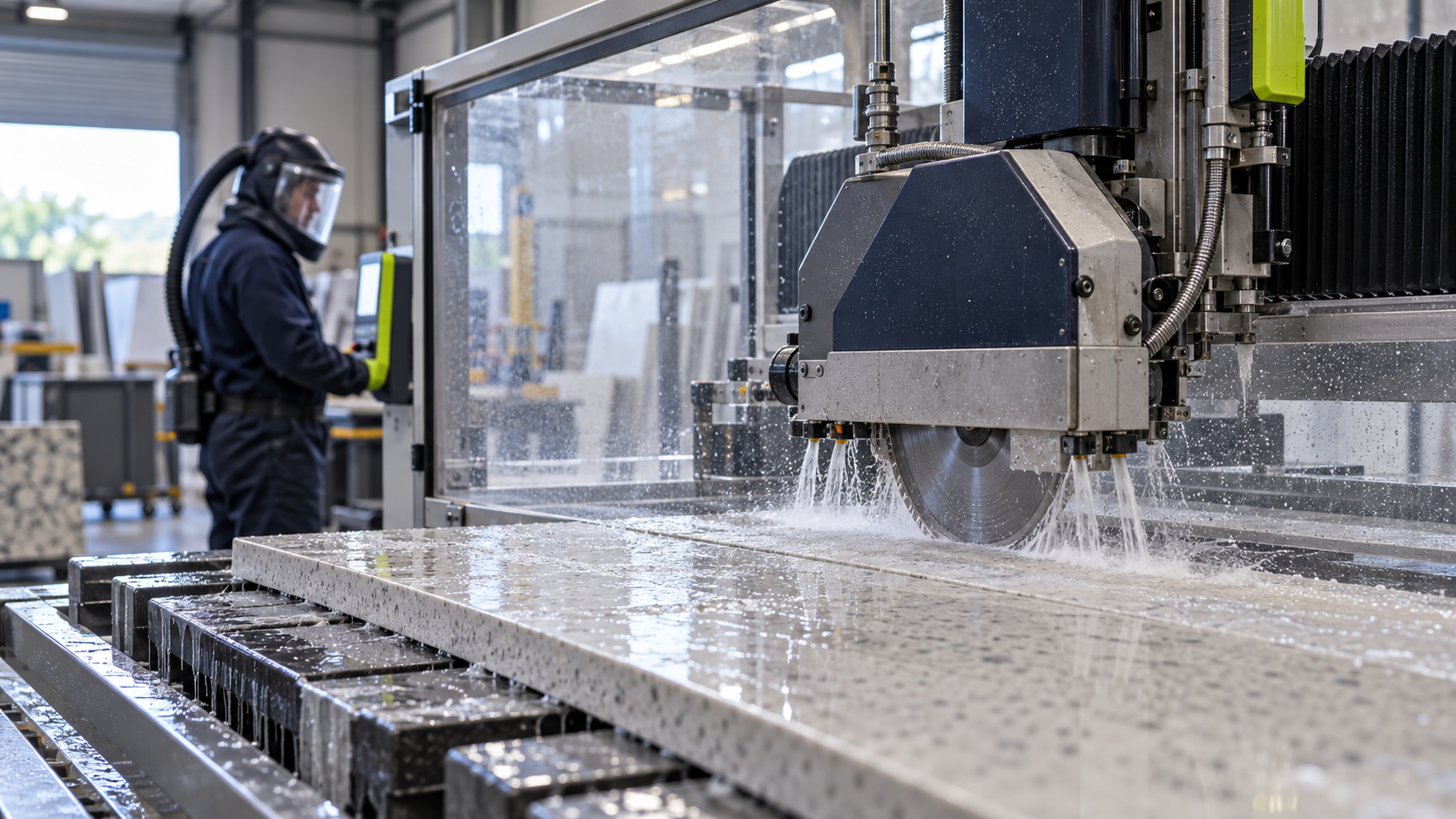
Why is HSE inspecting engineered stone businesses
The Health and Safety Executive (HSE) is stepping up inspections of businesses working with engineered stone across the UK. Its programme includes more than 1,000 planned visits during 2026/27, supported by new guidance on controlling respirable crystalline silica (RCS). [1]
For employers, the immediate priority is to review how exposure is prevented and controlled. HSE has clarified the standards it expects under existing law, rather than introduced a new statutory ban on engineered stone. [3]
The current attention also raises a wider question: how has a disease recognised for more than a century become a concern for workers producing modern kitchen and bathroom surfaces?
What is respirable crystalline silica
Silica occurs naturally in stone, sand and clay. Cutting, grinding or drilling silica-containing materials can release fine dust. The fraction small enough to reach deep into the lungs is called respirable crystalline silica, or RCS. Engineered stone is manufactured from crushed stone or minerals bonded with resin. [4,6]
The material composition matters. HSE gives the following approximate crystalline silica contents by weight. [5]
|
Material |
Approximate crystalline silica content |
|
Resin-based engineered stone |
Can contain up to around 95% |
|
Sandstone, gritstone and quartzite |
Above 70% |
|
Granite |
20% to 45%, typically 30% |
These percentages describe the bulk material, not the amount a worker breathes in. Exposure also depends on the process, tools, duration and controls. Natural stone can contain substantial silica too, so changing materials requires a fresh assessment of the actual product and task. [5,10]
How does silica dust cause silicosis
Inhaled crystalline silica can cause inflammation and scarring of lung tissue. This scarring, called fibrosis, reduces the lungs’ ability to function. Silicosis has no cure because the damage cannot be reversed. [6]
The National Health Service (NHS) explains that silicosis usually develops after 10 to 20 years of exposure, although very heavy exposure can occasionally cause disease within months. Symptoms may appear after exposure has stopped, and the condition can continue to worsen. [6]
HSE also identifies RCS as a cause of chronic obstructive pulmonary disease (COPD) and lung cancer. Workers may suffer damage before symptoms develop, which is why waiting for a persistent cough or breathlessness is an inadequate prevention strategy. [4]
How HAS silica awareness and regulations developed
Silicosis was an established occupational concern long before engineered stone worktops. A 1920 parliamentary answer discussed the serious risk in metal-grinding trades and the compensation powers provided by the Workmen’s Compensation (Silicosis) Act 1918. [8]
In 1930, the International Labour Office convened a silicosis conference in Johannesburg. Its agenda covered medical evidence, preventive measures and compensation. Almost a century later, those same questions remain relevant to new working processes and materials. [9]
The following milestones show how recognition of the hazard has developed into today’s regulatory approach.
|
Year |
Development |
|
1918 |
Specific British legislation enabled compensation schemes for silicosis. [8] |
|
1930 |
The International Labour Office brought experts together to examine silicosis, prevention and compensation. [9] |
|
1997 |
The International Agency for Research on Cancer classified crystalline silica inhaled as quartz or cristobalite from occupational sources as carcinogenic to humans, Group 1. [7] |
|
2002 |
The Control of Substances Hazardous to Health Regulations 2002 provide the framework for preventing or adequately controlling exposure to hazardous substances. [18] |
|
2006 |
Great Britain’s current RCS workplace exposure limit came into effect on 1 October. [11] |
|
2024 |
Australia introduced a ban on the manufacture, supply, processing and installation of engineered stone benchtops, panels and slabs, subject to defined exclusions and limited permitted work. [12] |
|
2026 |
HSE issued dedicated engineered stone guidance and expanded inspection and enforcement activity in Great Britain. [1,3] |
What does the evidence show about silicosis cases
A serious disease affecting younger workers
A 2024 case series in Thorax described the first eight reported cases in the United Kingdom (UK) associated with artificial stone. The men had a median age of 34. Four had worked with stone dust for only four to eight years. All had dry-cut or polished artificial stone worktops with inadequate safety measures. At the time of the report, one had died and two had been referred for lung transplant assessment. [13]
These were eight clinical cases, not an estimate of the proportion of the workforce affected. They demonstrate the potential severity of inadequately controlled exposure, including in younger workers.
Recorded cases are not the full disease burden
HSE’s 2025 statistics report shows that benefit-assessed new silicosis cases averaged 81 a year during 2005 to 2009, compared with 27 during 2015 to 2019. There were 40 new cases assessed in 2024. [14]
Separately, the Health and Occupation Reporting network had recorded 24 engineered-stone-related silicosis cases by the end of 2024. This reporting cut-off is not a current UK case total. HSE warns that its available sources probably substantially underestimate new cases and that recent overall trends are difficult to establish. We should read these different reporting systems separately rather than add their counts to estimate a national total. [14]
What screening studies can tell us
A 2023 study in Victoria, Australia, initially screened 544 stone benchtop workers. Of the 414 selected for detailed secondary screening, 117 were diagnosed with silicosis, more than one in four. [15]
That result applies to the selected screening group. It should not be presented as the prevalence among all Australian workers or transferred to the UK workforce. Prevalence describes the proportion of a defined population affected; counts of newly reported cases describe a different measure.
What are the current silica dust rules in Great Britain
The Control of Substances Hazardous to Health Regulations, usually called COSHH, require employers to prevent exposure where possible and adequately control it where prevention is not reasonably practicable. HSE’s advice starts with avoiding the hazardous substance or using a safer material or process. [10]
The RCS workplace exposure limit remains 0.1 milligrams per cubic metre of air, averaged over eight hours. This is an eight-hour time-weighted average, not permission for uncontrolled short bursts of dust. [16]
For carcinogens, exposure must also be reduced as low as is reasonably practicable, even when it is below the limit. A measurement below 0.1 mg/m³ does not remove the duty to apply effective good control practice. [17]
The current limit has applied since October 2006. A March 2026 parliamentary answer stated that HSE had no plans to review it. The new focus is on the materials, controls and working practices needed to manage exposure. [11]
What should companies do ahead of an HSE inspection
Review materials and the whole task
Review the COSHH assessment against the actual products and processes in use. Consider lower-silica materials and opportunities to avoid dusty processing. Include cleaning and maintenance in the assessment, alongside fabrication, because exposure can occur beyond the main cutting task. [4,10]
Our practical recommendation is to walk through a normal shift with the people doing the work. Check whether the controls described in the assessment are available, working and consistently used, including during short adjustments and maintenance.
Use source controls and manage contaminated mist
For cutting, grinding and polishing engineered stone with powered hand-held rotary tools, HSE’s ST3A guidance specifies on-tool water suppression. It describes a partially enclosed local exhaust ventilation (LEV) booth that vents outside and extracts wet mist, with mechanical ventilation to prevent mist build-up. [18]
Water use does not eliminate the hazard. HSE expressly warns that the mist generated during processing can contain crystalline silica and must be controlled. [4]
Provide suitable respiratory protection
For ST3A tasks, HSE specifies powered air-purifying respirators, or equivalent positive-pressure respiratory protection, with an assigned protection factor of at least 20. This rating indicates expected protection when equipment is correctly fitted and used. Workers need training in use and care. Tight-fitting equipment requires face-fit testing and a clean-shaven sealing area. [18]
Keep controls effective and prevent dust being spread
HSE recommends wet cleaning or vacuum equipment meeting at least dust Class M, the medium-hazard classification, rather than dry brushing or compressed air. Slurry should be managed before it dries and becomes an airborne dust source. Extraction systems require a thorough examination and test by a competent person at least every 14 months, with routine checks and maintenance between tests. [5]
Check exposure and arrange health surveillance
A competent occupational hygienist can advise on exposure assessment. Personal sampling measures air close to a worker’s breathing zone. HSE warns that static area samples are not personal exposure measurements and should not be compared directly with workplace exposure limits. Sampling should reflect normal working conditions and account for variation. [19]
Health surveillance is required where workers are regularly exposed to RCS and there is a reasonable likelihood that silicosis may develop. A competent occupational health professional should advise on the programme and review frequency. HSE says health records should be retained for at least 40 years from the last entry. Surveillance supports prevention; it does not replace effective exposure controls. [20]
What does the HSE focus mean for workers
Workers need to understand the controls, their checks and how to report faults. Training and supervision must cover normal work and control failures. [18]
Persistent coughing, breathlessness or unusual tiredness warrant medical advice. A general practitioner (GP) should be told about current and previous stone work and possible silica exposure. Workers should report concerns through workplace health and safety arrangements, and can raise concerns about inadequate controls with HSE. [1,6]
Where can wider-site dust suppression help
Engineered stone processing requires controls designed around the task and the worker’s breathing zone.
At Corgin, we provide installed Atomister misting systems and mobile MistCannon solutions for suitable wider-area or targeted dust suppression.
Our role is to assess where additional dust suppression may support the wider control strategy.
For suitable wider-site dust sources, talk to our team about dust suppression or explore our dust suppression solution finder.
References
Sources checked on 5 October 2026. Inspection figures are dated to 1 September 2026; disease reporting periods are identified in the text.
1. HSE, HSE says no dry cutting of engineered stone ahead of inspection crackdown, 11 May 2026.
2. UK Parliament, written question 27026, Silica Health Hazards, answered 11 September 2026.
4. HSE, Working engineered stone Control silica risk, updated 29 April 2026.
5. HSE, COSHH essentials for stone workers ST0 Advice for managers.
6. NHS, Silicosis, reviewed 23 January 2024.
7. International Agency for Research on Cancer, Silica, Volume 68, 1997, summary and evaluation.
8. UK Parliament, Hansard, Workmen’s Compensation Silicosis Act 1918, 29 March 1920.
10. HSE, COSHH What you need to do.
11. UK Parliament, written question 118292, Silica Health Hazards, answered 18 March 2026.
12. Safe Work Australia, Silica Engineered stone ban.
13. Feary J and colleagues, Artificial stone silicosis a UK case series, Thorax 2024, 79, pages 979 to 981, DOI 10.1136/thorax-2024-221715. Author institution summary.
14. HSE, Silicosis and coal workers’ pneumoconiosis statistics in Great Britain 2025.
15. Hoy RF and colleagues, Prevalence and risk factors for silicosis among a large cohort of stone benchtop industry workers, Occupational and Environmental Medicine 2023, 80, pages 439 to 446, DOI 10.1136/oemed-2023-108892. Author institution abstract.
16. HSE, EH40 Workplace exposure limits, silica entry in Table 1.
17. HSE, COSHH Workplace exposure limits.
18. HSE, ST3A Cutting and polishing engineered stone using powered hand-held rotary tools.
19. HSE, G409 Exposure measurement Air sampling.
20. HSE, G404 Health surveillance for those exposed to respirable crystalline silica.
21. Corgin, Dust suppression solution finder, application guidance.
22. Corgin, AtomisterAiro, product information.


Share This Post
LinkedIn Facebook Twitter Google Plus Email