-1.png?width=860&height=350&name=Corgin%2025%20Years%20Primary%20Logo%20Landscape%20(RGB)-1.png)


Yes, is it.
If your site generates dust and you're not controlling it, you're breaking the law. Probably more than one law, actually.
But let's not just leave it at "yes" because the why is where it gets interesting. And the when is where most people get it wrong.
The legal bit (it's not just one regulation)
What catches people off guard is that dust doesn't sit under one tidy piece of legislation. It comes at you from several directions at once.
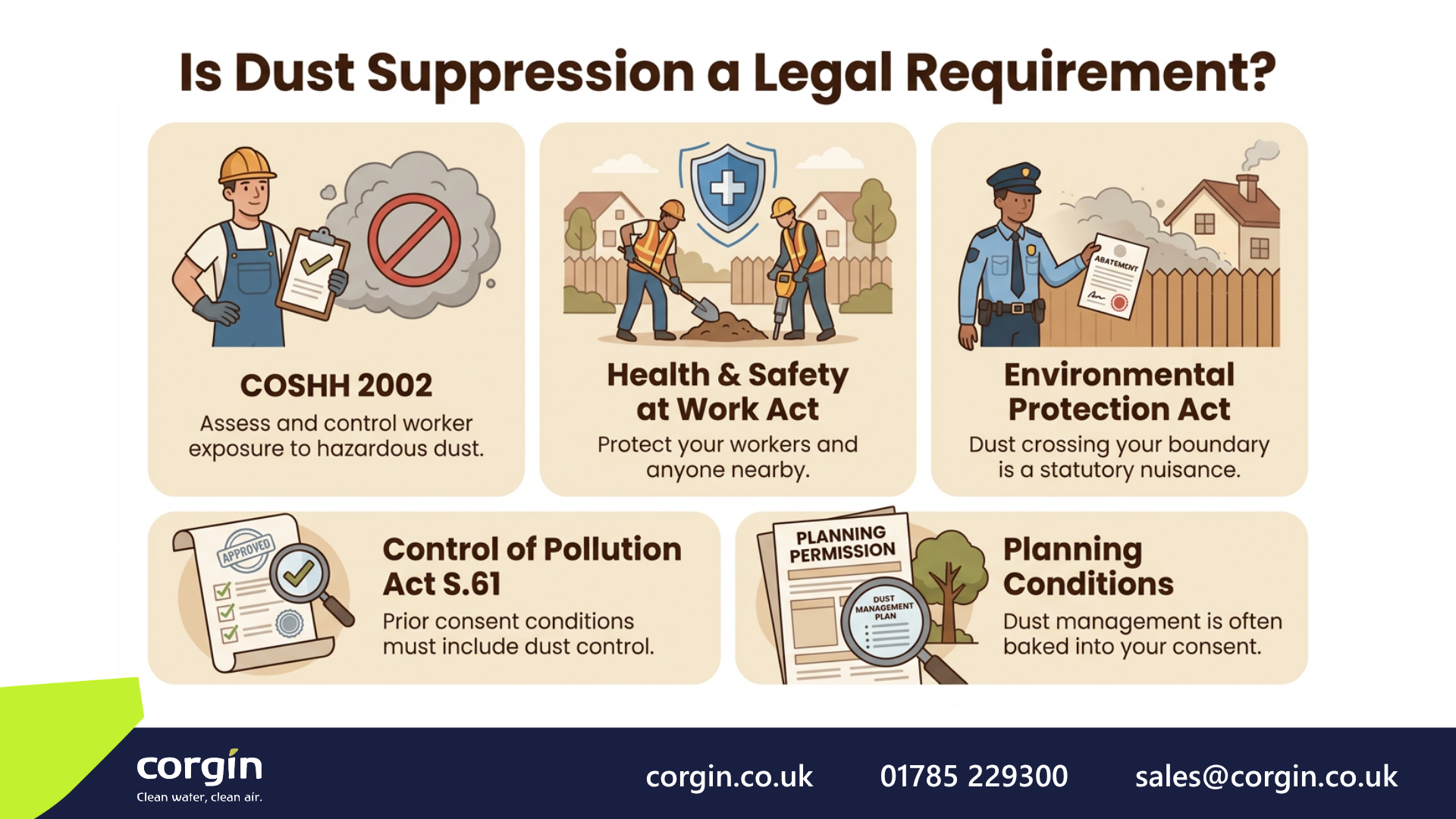
COSHH Regulations 2002
This is the big one. If your workers are exposed to dust - particularly respirable crystalline silica, which is generated when materials like concrete, brick, or sandstone are cut, drilled, or disturbed - you're required to assess and control that exposure. The workplace exposure limit (WEL) is 0.1 mg/m³ over an 8-hour time-weighted average (TWA). That may seem small, but silica is a Group 1 carcinogen, and will cause silicosis, COPD, and cancer.
Health and Safety at Work Act 1974
This places a general duty on employers to ensure, so far as is reasonably practicable, the health, safety, and welfare of employees - and to protect anyone else who might be affected by their work activities. On a dusty site, that extends beyond the boundary: neighbouring residents, pedestrians, and anyone in the vicinity.
Environmental Protection Act 1990, Part III
This is the one that bites when dust leaves your boundary. It's classed as a statutory nuisance which means anything that unreasonably interferes with the use or enjoyment of land, or is prejudicial to health. Your local authority has a duty to investigate complaints and, if satisfied, must serve an abatement notice requiring you to stop or limit the nuisance within a set timeframe. Non-compliance is a criminal offence, with fines of up to £20,000 for industrial or commercial premises.
Section 61, Control of Pollution Act 1974
If you've applied for prior consent under Section 61 - which allows you to agree working methods with the local authority before construction begins - dust control conditions will almost certainly be attached as part of that consent. These conditions are legally binding. Breaching them doesn't just expose you to enforcement action from the local authority; it also undermines the protection that prior consent was supposed to give you in the first place.
CDM 2015, Part 4
Construction sites must be kept safe and without risks to health. Dust in the air is a risk to health, and that's not really up for debate. Under Regulation 36, contractors must ensure that work is carried out without risks to health - which includes airborne dust from cutting, demolition, or earthworks. The principal contractor is responsible for coordinating this across the site. Failure to comply can result in HSE enforcement action, including improvement or prohibition notices.
Planning Conditions
Increasingly common on anything near residential areas, but not limited to them. Your planning officer may have attached dust management requirements as a condition of approval - specifying control measures, monitoring, or even a formal Dust Management Plan. These are legally binding, so if breach them and the local planning authority can serve a stop notice, halting work entirely. Whether you've actually read your planning conditions is... another question entirely.
What you're expected to do before you start
The law says to plan for dust BEFORE it becomes a problem i.e. before the first dig.
That means completing a proper dust risk assessment as part of your COSHH assessment - one that's specific to your site and the tasks you're actually carrying out (not a recycled template from a previous job). You need to identify what work is being done, what materials are being disturbed, and where the dust is likely to travel.
For permitted sites, the Environment Agency often wants a Dust & Emissions Management Plan. This is a formal document that sets out how your site will identify, assess, and control dust and emissions throughout the project - covering everything from the sources of dust and the control measures you'll use, to monitoring procedures, complaint handling, and who's responsible for what. Even when it's not formally required, having one means you've thought about it, which matters when someone official comes knocking.
And the hierarchy of control still applies here, same as everything else in H&S. Eliminate first. Then engineering controls (that's where dust suppression lives). Then admin. PPE last - not first. The HSE has been banging this drum for years. You can read more about this in our post talking about ERIC PD's glasses.
Why it has to happen before the dust, not after
This is the bit Steve never quite gets.
Dust suppression is preventative. Once it's airborne and drifting across your boundary, you've failed. You're not suppressing anything at that point, but reacting to a problem that's already happened.
The HSE expects source control, which means to stop it from being created, or capture it the moment it's generated. That means having the right kit, in the right place, before the work begins.
Sites that get this right plan in Q1 and Q2. They book equipment in before summer starts and they identify dust sources during pre-construction and build suppression into the programme, same as they'd build in crane time or concrete pours.
The escalation when you don't plan
When the dust leaves your boundary it may be visible, but it also might not be. You neighbour might notice - maybe it's on their windowsill or their kid's wheezing, so they call the council.
The council investigates and if it's bad, they'll issue an abatement notice under the Environmental Protection Act., which means you've now got a legal deadline.
Meanwhile the HSE might visit independently, and if they see uncontrolled dust with no suppression in place, they may issue an improvement notice. Or, if someone's clearly exposed, a prohibition notice which means work stops immediately.
If you've also breached planning conditions, the local planning authority can serve a stop notice too.
This can all result in programme delays, liquidated damages, reputational damage, and your client asking questions you don't have answers for.
All because nobody thought about dust suppression in March.
How often should it actually be applied?
We get asked this a lot. And the answer is frustratingly simple: whenever dust-generating work is happening.
So your MistCannon should be running whenever the crusher is running. Your DustFast application goes down on haul roads before vehicles start using them, and lasts 6-16 weeks without reapplication. Your DustLayer runs at the loading point whenever loading is happening.
And if you see dust being generated when nothing is in operation? It's good to look into whether you have stockpiles or exposed dusty surfaces that need treating with dust suppressant consumables that keep the dust contained.
Get it sorted before you need it urgently
If you want help figuring out what you actually need for your specific site, that's what we do. At Corgin, we advise, supply the kit, and support you with after sales support too. We're not just dropping off equipment and disappearing.
Plan it now, before you're already in trouble. Don't be like Steve.


Share This Post
LinkedIn Facebook Twitter Google Plus Email