-1.png?width=860&height=350&name=Corgin%2025%20Years%20Primary%20Logo%20Landscape%20(RGB)-1.png)


Water is the most common approach to dust suppression on construction sites, demolition projects, quarries, and bulk material handling operations. So when you're using it and the dust is still there, it's understandably frustrating.
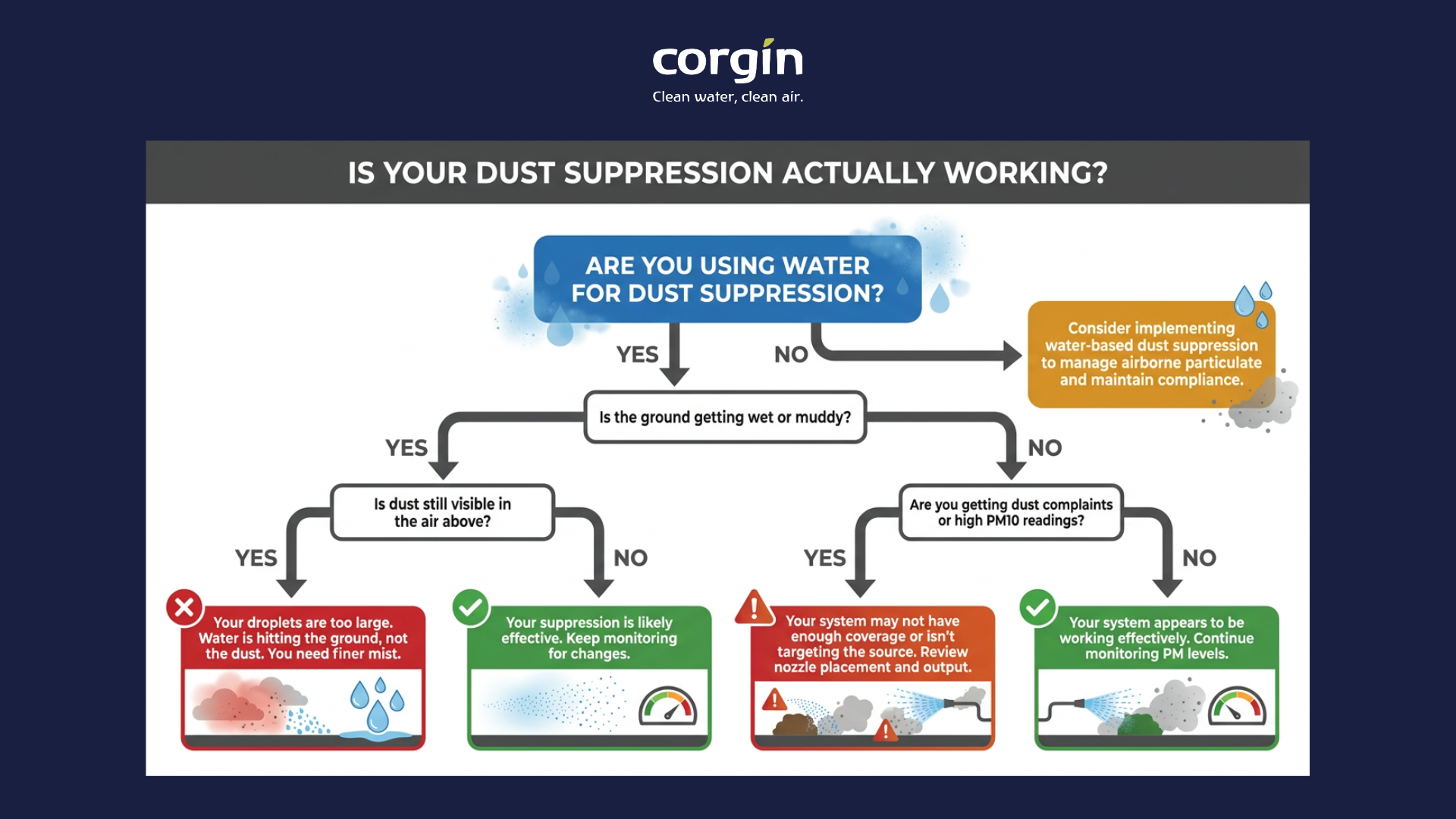
The short answer: water isn't controlling your dust because the droplets your system produces are too large to capture fine airborne particles. Traditional systems create heavy spray that falls too quickly, passing straight through respirable dust instead of binding to it.
But there's more to it than that. And understanding why this happens is the first step to actually fixing it.
Why is my dust suppression system not working?
Most traditional dust suppression setups, things like rotary atomisers and high-volume spray bars, produce quite large water droplets. Visually, it looks effective. You can see the spray, you can see things getting wet. Seems like it's doing its job.
What's actually happening is counterintuitive. Those large droplets push fine dust particles away rather than capturing them. Think of it like a car driving past a leaf on the pavement. The airflow moves the leaf around instead of hitting it directly. Same principle.

Large droplets:
- Fall too quickly to interact with airborne dust
- Don't stay suspended long enough to make contact with fine particles
- Miss respirable dust
- Often create wet, messy conditions without solving the underlying problem
So you end up with puddles on the ground and dust still hanging in the air above it.
How does water droplet size affect dust suppression?
This is where the science actually matters, and where most people haven't thought about what's happening at particle level.
Effective dust suppression depends on collision probability. Water droplets need to physically collide with dust particles in the air, bind to them, and bring them to the ground. That's the mechanism.
For those collisions to happen, a few things need to line up. The droplets need to be similar in size to the dust particles they're trying to capture. They need to be moving slowly enough to remain in the same airspace. And they need to stay suspended long enough for the interaction to take place.

When those conditions are met, collision rates increase dramatically. More collisions means more dust captured. Fewer collisions means... what you're probably experiencing right now.
Large droplets from traditional systems fail on all three counts. They're far too big relative to fine respirable dust. They fall too fast. And they pass through the dust cloud before any meaningful contact occurs.
Does adding more water fix the problem?
The natural instinct when dust isn't controlled is to increase output. More water, higher pressure, longer run times.
Sometimes that helps marginally. But often the improvement is limited because you haven't changed the fundamental behaviour of the droplets. They're still large. Still falling fast. Still passing through rather than interacting.
What you end up with is wetter conditions on the ground, possibly mud and tracking across site, but the airborne dust persists. You've created a different problem without solving the first one.
How do you effectively suppress fine dust on a construction site?
This is where droplet size becomes everything.
When water is broken down into ultra-fine mist rather than heavy spray, the physics shift in your favour. Smaller droplets stay suspended in the air for longer. They move slowly. They sit in the same space as airborne dust particles long enough to actually make contact and bind.
Air atomising nozzle technology achieves this by using compressed air to shatter water into extremely fine droplets. The result is a controlled, slow-moving mist cloud that maximises airborne contact time and targets dust at its source.
No over-wetting. No puddles. No mud. Just dust particles being captured where they actually are: in the air.
This approach is particularly effective for:
- Construction and demolition sites generating fine dust
- Conveyor transfer points and bulk material handling
- Quarries and aggregate processing
- Industrial facilities handling dry powders and solids
- Any environment producing respirable PM10 or PM2.5 dust
What are the risks of poor dust control on site?
Dust isn't just a visual nuisance. Uncontrolled airborne dust carries real consequences that affect compliance, health, and your bottom line.
Worker exposure to respirable particles (PM10 and PM2.5) is a serious health risk. Silica dust from construction and demolition activities can cause silicosis and other chronic respiratory conditions. Regulators don't take this lightly.
Beyond health, there's environmental complaints from neighbours that can escalate quickly. Regulatory enforcement action and potential penalties. Product loss from material going airborne. And reduced visibility creating safety hazards that are easy to overlook until something goes wrong.
Getting dust control right is about a lot more than just keeping things compliant.
Final thoughts
If water isn't controlling the dust on your site, it usually isn't because water is the wrong approach. More often, it's because the delivery method doesn't match the physics of what you're trying to capture.
Smaller droplets, slower movement and longer suspension time - not more water, but smarter water.
But if you're concerned about the amount of water you're using on site, or you'd like to cut long-term costs, read up on our long-term dust suppressant DustFast where just one application can last 6-16 weeks.


Share This Post
LinkedIn Facebook Twitter Google Plus Email